

The state of cigar humidity control in 2026
by Abraham Wolke
If you have been around cigars for a while, you have heard 70/70: 70% RH and about 70°F. That was the number your local tobacconist recommended. It was in the magazines and built into the foam puck that came with your humidor.
The recommendation did not come from deeply technical research that had established the perfect way to store a cigar. The old humidity-control solution simply tended to land near 70% RH. It worked, and 70/70 became the standard.
Why 70/70 became the standard
Before two-way humidity packs were common, most humidors used a sponge, foam, or crystal puck charged with propylene glycol (the “50/50” or “wetting solution”) and distilled water.
Gary Korb at Cigar Advisor / Famous Smoke Shop, walking through how to fill a humidifier:
“Although you can use either one in your humidifier, it's really preferable to go with the 50/50 solution.”
“It's also called polyglycol solution, and it's a pre-mixed combination of distilled water and propylene glycol … and it's very effective for preventing mold.”
“The solution as it evaporates does so at about a 70 percent relative humidity, and that also helps maintain a very nice RH level in your humidor.”
Watch: How to fill a humidor humidifier: PG vs Distilled (00:16–02:27).
That mixture does not wander the way plain water can. As it evaporates, it tends to hold around 70% RH. The equipment made 70% practical, and the recommendation followed.
Steve Saka of Dunbarton Tobacco & Trust, talking with Tim Swanson of Cigars Daily, puts the same history in blender language:
“You have to understand that the standard of 70/70 was a byproduct of the way the [humidification] agents used to work. Everybody used to use propylene glycol, right? And propylene glycol mixed with distilled water would give you 70% relative humidity. So it was the only way that was even semi-functional. So we just made it the standard because it kind of became the standard.”
Watch: Steve Saka Reveals: The Ultimate Cigar Storage Mistakes to Avoid, a Cigars Daily conversation with host Tim Swanson (04:11–06:23).
The number stuck because the equipment kept pointing to it. Today, smokers have more control over humidity and more ways to store their cigars. Many blenders also recommend lower settings.
If your cigars smoke the way you like at 70%, keep doing what works. This article is about how storage has changed and what many people in the industry recommend today.
Humidity packs let you choose the RH you want
Two-way humidity packs release moisture when a humidor is dry and absorb it when conditions are wet. Instead of inheriting 70% from your propylene glycol solution, you can choose 65, 69, or 72 and keep the humidor near that target.
Once people could choose the number, many of them chose to go lower.
We hear it from our customers, and from plenty of people who spend their lives around cigars: most cigars sit better in the mid-60s. For many smokers, that means 65–68% RH. Some go lower, to about 60–62%, especially with heavier New World blends.
That does not mean 65% won a universal lab test. It means aficionados and many cigar professionals have moved in that direction now that the number is optional.
Why more people store cigars in plastic
More people now keep their cigars in plastic instead of wood humidors. They use Tupperdors, coolers, food tubs, and even sealed bags. A wood humidor still looks right on a desk. It is also a good place to keep a smaller rotation of cigars ready to smoke or to bring out for a dinner or shop event. But it is no longer the only good way to store cigars, and many people outgrow a desktop humidor quickly.
Most of us own more cigars than we will smoke this year. A cooler or a tight plastic bin gives that collection room to grow and has a seal that is easier to maintain. Two-way humidity packs in a low-leakage plastic container stay closer to the target printed on the pack. Wood can make the system settle lower than the pack rating. Plastic does not.
Factories now freeze and fumigate cigars, taking on work that once fell to merchants and hobbyists (CORESTA freeze guidance; Habanos export freezing). Tobacco beetles can still be a real problem, especially when cigars are stored too warm and too wet. That is another good reason storage recommendations have moved a little lower on the RH scale. You still need to keep cigars in a cool space, but you do not need a cedar-lined humidor to store them. For a large collection, you usually need enough room, a tight lid, and a humidity pack you can replace. Plastic handles that job well.
Cigars changed too
Humidity packs changed the way people control their storage. The cigars themselves were changing at the same time.
Chris from Luxury Cigar Club talks about that change in this video:
“A lot of Cuban cigars use tobaccos from Nicaragua, Dominican Republic, Costa Rica, Honduras. Cuba doesn't grow enough tobacco to supply the amount of cigars that they are supplying and producing worldwide. Ever since Cuban tobacco was nationalized by the Cuban government, they haven't really innovated. The masters have left Cuba, they went and they started other brands. They are the innovators of this industry. They're the ones that have been pushing cigars forward. And when Castro took over and nationalized tobacco inside Cuba, they left. So you have people inside Cuba that really know what they're doing, but they're not driving forward, they're not pushing the cutting edge.”
New World makers kept changing how the leaf is grown and processed and how the cigars are made. The result was heavier filler, longer fermentation, and different handling. Those cigars often smoke better a little drier.
Steve Saka, in the same Cigars Daily conversation with Tim Swanson, explains why wetter storage worked for many older cigars and why it often does not work as well for today’s blends:
“Back in the day the cigars were much milder and lighter in body, so they were okay to store and smoke a little wetter. So if you're smoking really light materials, mild cigars, shade wrappers, you can get away with a higher humidity level. But so many cigars today are made with much heavier ligero fillers. They're much more hygroscopic — meaning they absorb more moisture naturally — and they tend to smoke much better at a lower humidity.”
Watch: Steve Saka Reveals: The Ultimate Cigar Storage Mistakes to Avoid (04:11–06:23).
Many modern cigars also arrive ready to smoke. If a new box is not quite where you want it, the cigars may need a little time to settle, but they do not necessarily need years of aging.
Saka’s advice when you open a new box:
“I always tell people when they buy like a new box, smoke one or two quick out of the box, and if you're not really happy with it just set it aside for a week, give it a chance to stabilize.”
Saka is talking about giving the box a week to settle. Nick Perdomo says the factory has already put years into the tobacco:
“The minimum age of the tobacco in our cigars is three to six years old.”
For many modern cigars, much of that aging has already happened before the box reaches you. (Famous Smoke Shop / Cigar Advisor)
Old World guidance starts lower for a different reason. Habanos, S.A. recommends 65–70% RH at 16–18°C for keeping Habanos. The company also says Habanos can be kept for 15 years and improve with age because the filler leaves need time to come together.
The New World and the Old World reached lower storage ranges for different reasons, but they have moved in the same direction.
What cigar makers recommend today
Nick Perdomo on origin and texture, from Cigar MythBusters, Ep. 7 (02:57–03:37):
“Even thinner tobaccos from more loamy and sandier grounds like Cuba and the Dominican Republic — I would venture to say 68% humidity would be optimum for those cigars. As technology and seed varieties change, even those tobaccos have more texture today. Definitely Nicaraguan cigars at 65% humidity. That is the sweet spot for our cigars.”
Steve Saka, in the same Cigars Daily conversation with Tim Swanson (04:53–05:55), explains how low he will go depending on the humidor:
“On a super super heavy blend you can ramp that sucker down to 61 and it still is fine. 63, 64, 65 I would guess is probably ideal. So personally it's a compromise. … Unless you have all heavy-body cigars in your humidor — then if you're that person, 63–65. But if you're somebody like me that has a mixture of things in your humidor, I find 67 to be the compromise.”
“I think 67 is a really good target. … Pretty much anything in that 61 to 70 at the very upper end could be the right humidity for you. But I find that staying in that 65–67 kind of range is probably the one that's the best overall in general.”
Retail advice for aging cigars lands in the same neighborhood. Holt’s on aging cigars recommends 63–65% RH for deliberate aging.
Those recommendations come from the makers themselves.
If you normally store at 69% or 72% but want to try your favorite blender’s recommendation, move down one step and see how the cigars smoke.
Why cigars still ship at 69 or 72
Factories often store cigars drier than they ship them. Extra moisture in the box is protection. A drier cigar is more likely to crack or break in transit.
That is why a new box often feels a little wet, and why people rest cigars for a couple of weeks after they arrive. The cigars are coming down from the shipping humidity, not recovering from a mistake.
69% and 72% packs are still important for that job. If you store at 65%, that does not mean the people who shipped your cigars used the wrong number.
72% is the number for extended shipping
69% can cover a short trip. For extended shipping, 72% is the better protection. The extra moisture is what keeps wrappers from drying and cracking over a longer haul.
Once the box is home, move the cigars into your normal storage and let them settle. The 72% pack did the shipping job. It is not a claim that you have to store at 72%.
How Valet's guidance is changing
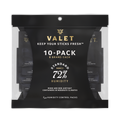
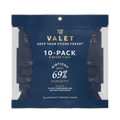
Valet still makes 65%, 69%, 72%, 75%, and 84%. The formulas are not changing, and our packs will perform the same way they always have.
Our recommendations are changing, along with the way we explain what each pack is for.
We now recommend that most customers start with 65% instead of 69 or 72. Move to 69% if you prefer a slightly softer smoke or use a wood humidor.
Moving down does not need to be dramatic. If you use 72%, try 69%. If you use 69%, try 65%.
We are launching a 62% pack for cigar smokers who already prefer the dry side of the range. Sign up to be notified when it is available.
We are no longer recommending 75% for storage. We may eventually make 75% a calibration-only product, but we have not made that decision. If you use a lot of 75% packs, we would like to hear from you.
Curious about the mid-60s? Shop Valet 65% humidity packs for plastic containers.
What 84% is for
84% is for seasoning wood humidors and cedar. Put it in an empty wood humidor for about two weeks, then remove it. Do not use 84% for cigar storage.
You can also use 84% to season cedar inside a plastic humidor. Dry cedar will absorb moisture from your humidity packs before that moisture reaches the cigars. Season the cedar first, then switch to the humidity pack you plan to use for storage.
Our packaging will take longer to change because we still have printed film in stock. As we print new packaging, we will update our education and recommendations for a 65–68% RH range instead of 68–71%. The new graphics will roll out on our website, Amazon, and other channels over the coming months. Until the updated wrapper reaches your SKU, You can always rely on The System for our current guidance based on the latest industry knowledge.
The next time you refill your humidor, try the mid-60s and see how your favorite cigars smoke. If you find a better setpoint, let us know.
Ready to try the mid-60s? Shop Valet 65% humidity packs for plastic, or Valet 69% for wood.